GUIDE — TOUCH TYPING 7-DAY ROADMAP
How to Learn Touch Typing — A 7-Day Roadmap Starting from Home Position
- Published
- Updated
- Author
- Typing Musou Developer(Student & solo developer)
You decide to learn touch typing, and three days in you're slower than before, peeking at your keys every other word, ready to give up — sound familiar? The first wall is almost always here.
The honest truth is that touch typing doesn't take talent or willpower. It takes the right order of practice and 10–15 minutes a day for a week. I learned it that way myself: the first three days felt rough, my speed dropped, and then around day 4 my eyes started staying on the screen on their own. By day 7 I was a different typist.
This article publishes that schedule, day by day. Each day's drills map to the Typing Musou Home Position Dojo (100 stages, guided by the master one key at a time), Speed Trial and Mock Combat, so you can read and practice in the same browser tab.
“Touch typing” and “blind touch” mean essentially the same thing — touch typing is the international term, blind touch is a Japanese-localized name for it. This article uses them interchangeably.
ESSENCE
The essence: 7 days × the right order
Before any of the daily drills, the load-bearing point: the difference between people who learn touch typing and people who give up isn't talent. It's almost always these two:
1. Don't break the order of key expansion
Left home → right home → top row → bottom row. Skip a step or try every key at once and you'll burn out. Keep the order and a week is plenty.
2. 10–15 minutes a day, every day
Daily reps beat a single weekend cram. Motor skills consolidate during sleep, so gaps cost you yesterday's gains.
If you follow those two rules, you don't need willpower. The Day 1–7 roadmap below just executes them as a concrete daily schedule.
DEFINITION
What touch typing actually is — and “blind touch”
Touch typing means typing without looking at the keyboard — eyes on the screen the whole time. The Japanese term “blind touch” is the same skill; the names come from different teaching traditions, but the technique is identical.
When you get it, three things follow:
You stop looking down
The screen ↔ keyboard ping-pong vanishes. Effective speed jumps 30–40% from just removing that cost.
Finger travel is minimized
Each finger has a lane, no random hand drift, much less fatigue over long sessions.
Mistakes become legible
“This word always trips me up” becomes “my right ring finger isn't moving.” Vague weaknesses become fixable weaknesses.
While you're still looking at the keys, none of those three are available to you. If you've felt a “want to get faster but can't” plateau, that's almost always the cause.
PREP
Setup — keyboard, chair, F/J bumps
Spend five minutes on this before Day 1. Skipping setup means redoing it midway through the week.
1. Any keyboard works (laptop built-in is fine)
Mechanical, membrane, laptop chiclet — all fine for learning. Don't postpone starting because you want to buy a new keyboard first. After a week of practice, you'll know your preferences anyway.
2. Chair height: elbows at about 90°
Arms over-extended or pulled too close kills your ring and pinky reach. One adjustment now makes the next 7 days much easier.
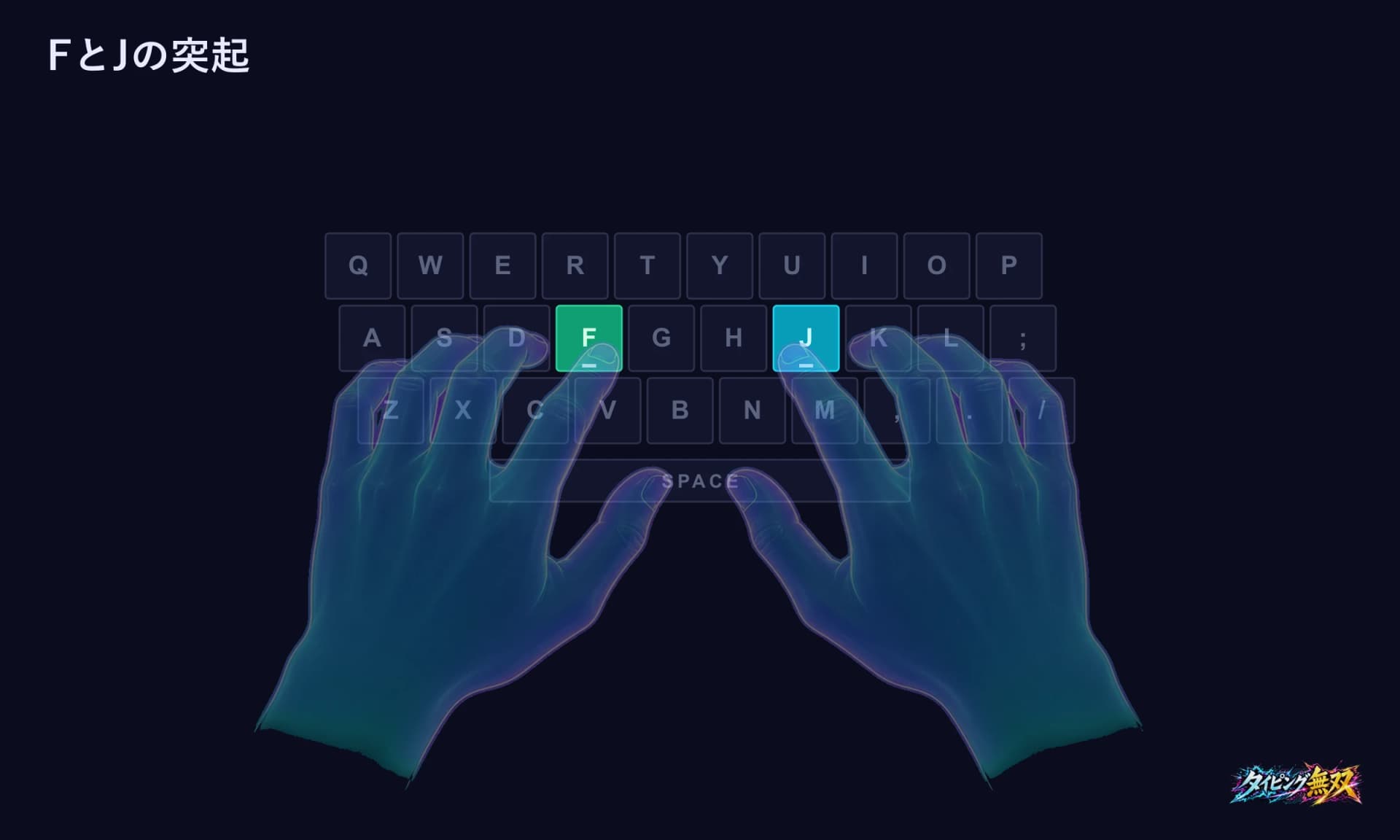
3. Find the F and J bumps with your fingers
The whole point of touch typing starts here. Both keys have small tactile bumps for the index fingers; the goal of Day 1 is to land on them with eyes closed.
OVERVIEW
7-Day roadmap at a glance
At 10–15 minutes a day, this schedule builds touch typing in a week. Each day maps to the Typing Musou Home Position Dojo (100 stages, master-guided), Speed Trial or Mock Combat.
| Day | Theme | Dojo | Time | Checkpoint |
|---|---|---|---|---|
| Day 1 | Left home row | Home Position Dojo (home row) | 10–15 min | Find F's bump without looking |
| Day 2 | Add right home row | Home Position Dojo (home row) | 10–15 min | Find J's bump without looking |
| Day 3 | Both hands + first WPM | Home Position Dojo + Speed Trial | 15 min | First WPM recorded; alternation feels fluid |
| Day 4 | Top row, left | Home Position Dojo | 10–15 min | Left fingers reach up and return home |
| Day 5 | Top row, right (all 5 vowels) | Home Position Dojo | 10–15 min | Type a/i/u/e/o without looking |
| Day 6 | Bottom row + full keyboard | Home Position Dojo | 15–20 min | Type everyday words across all 26 keys |
| Day 7 | Sentences → Mock Combat | Sentences + Mock Combat (Apprentice) | 20–30 min | Beat the Apprentice (WPM 30 / 85%) |
Don't reorder the days. The two failure modes I personally hit during my self-taught years were skipping home row to start higher, and trying to learn both hands on the same day — both cost me months of stalled progress.
DAY 01
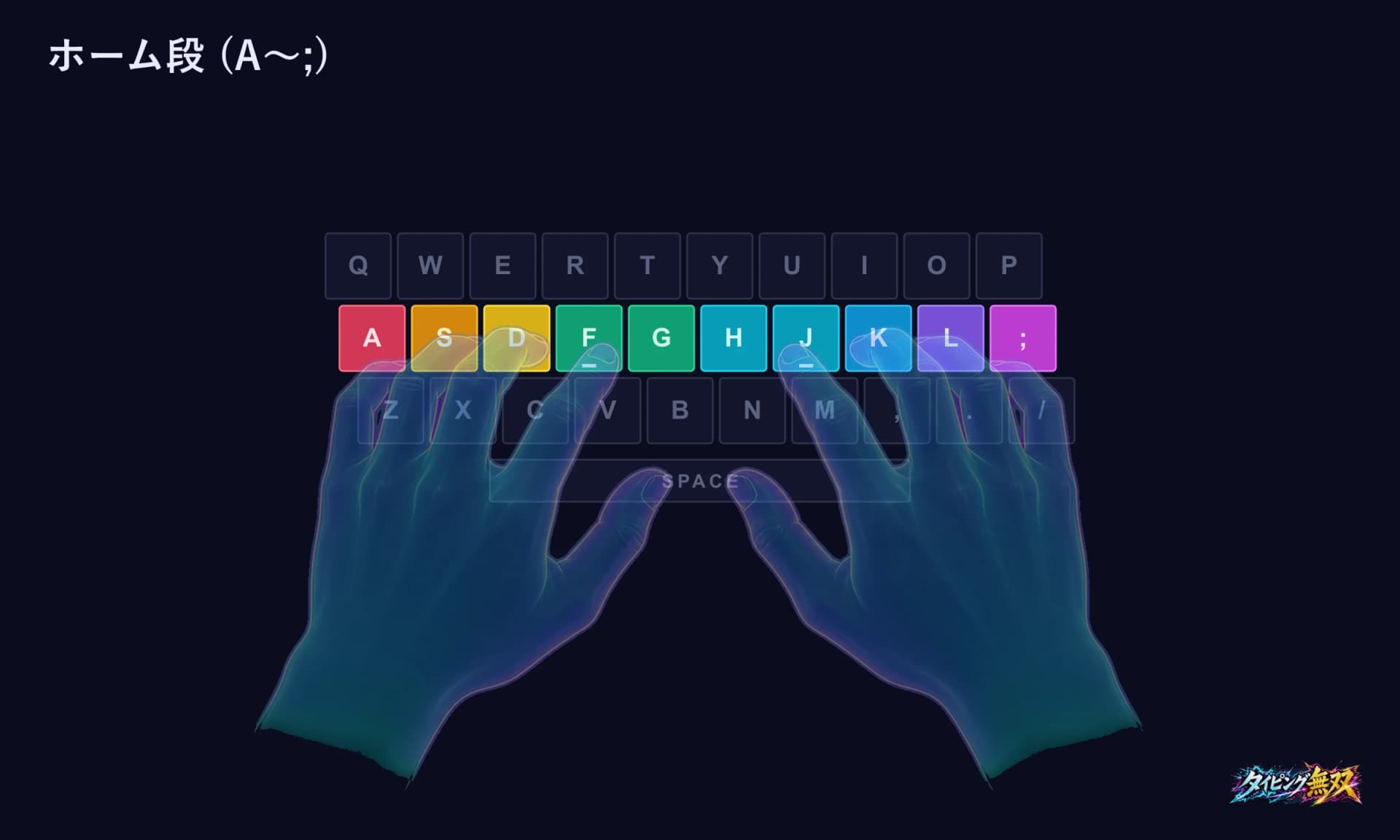
Day 1 — Left home row (A·S·D·F·G)
Day's goal
Left-hand fingers + thumb land on A·S·D·F·G with eyes closed.
Today is just this. Pinky on A, ring on S, middle on D, index on F, and index reaches G when needed. Thumb on Space. Don't move past this state until it feels effortless — if you do, things break by Day 5.
The check: can you find F's bump without looking? Eyes on the screen, left hand only.
Steps
- 01.Land the left index pad on the F bump (the other 3 fingers follow)
- 02.Thumb rests on Space
- 03.Open the Home Position Dojo (100 stages, guided by the master) and practice the left half of the home row
- 04.Type the words shown, strictly with the correct finger
- 05.After every word, return the whole left hand to home row
Practice volumeThe home row opens with words built from the 5 left-home keys. Type them once, keeping finger discipline, and Day 1 is done.
DAY 02
Day 2 — Add the right home row (H·J·K·L)
Day's goal
Right-hand fingers land on J·K·L·;, so all 8 home keys + thumbs are covered.
Day 2 adds the right hand. Index on J (the bump), middle K, ring L, pinky ;. Mirror Day 1's drill: feel J's bump with eyes on the screen.
Right-home keys come up more often than left-home ones in Japanese romaji (k/h/m rows live here). Resist the urge to grab a neighbor with the wrong finger — that mistake snowballs.
Steps
- 01.Anchor both indices on F and J first
- 02.Set the right ring on L and pinky on ;
- 03.In the Home Position Dojo (100 stages, master-guided), practice the right half of the home row
- 04.Type the words using only the correct finger per key
- 05.After each word, touch J's bump again to confirm
Practice volumeThe right-home words use right-home + Day 1's left-home keys only. One clean run with correct fingers is enough for Day 2.
DAY 03
Day 3 — Both hands + first WPM reading
Day's goal
Type alternating left/right home-row words fluidly, and log your first WPM number.
Two parts today: combined home-row drill, then your first measurement.
Words that bounce between left and right home are the foundation of real typing speed. If alternation feels jerky, no amount of single-hand drilling will fix it.
Then you measure. Typing Musou's Speed Trial is a time-attack against a 5,000 HP sandbag. It logs clear time, WPM, accuracy and best combo on every run. The wordlist is fixed (5 short / 10 medium / 5 long, 20 total), which means when you re-test on Day 7, you'll compare apples to apples.
Don't worry about which row of the WPM benchmark you land in — the point is having recorded a number. Day 3 plus Day 7 gives you two points on a line, which is what keeps motivation alive past week 1.
Steps
- 01.In the Home Position Dojo, progress to where both home rows alternate
- 02.Open Speed Trial
- 03.Run a single 20-word session to the end
- 04.Save the WPM / accuracy / clear time (screenshot is fine)
- 05.Day 3 done — you can stop here
Practice volumeOnce the Dojo has you alternating left/right home keys word by word, the Speed Trial run becomes your week-1 benchmark.
DAY 04
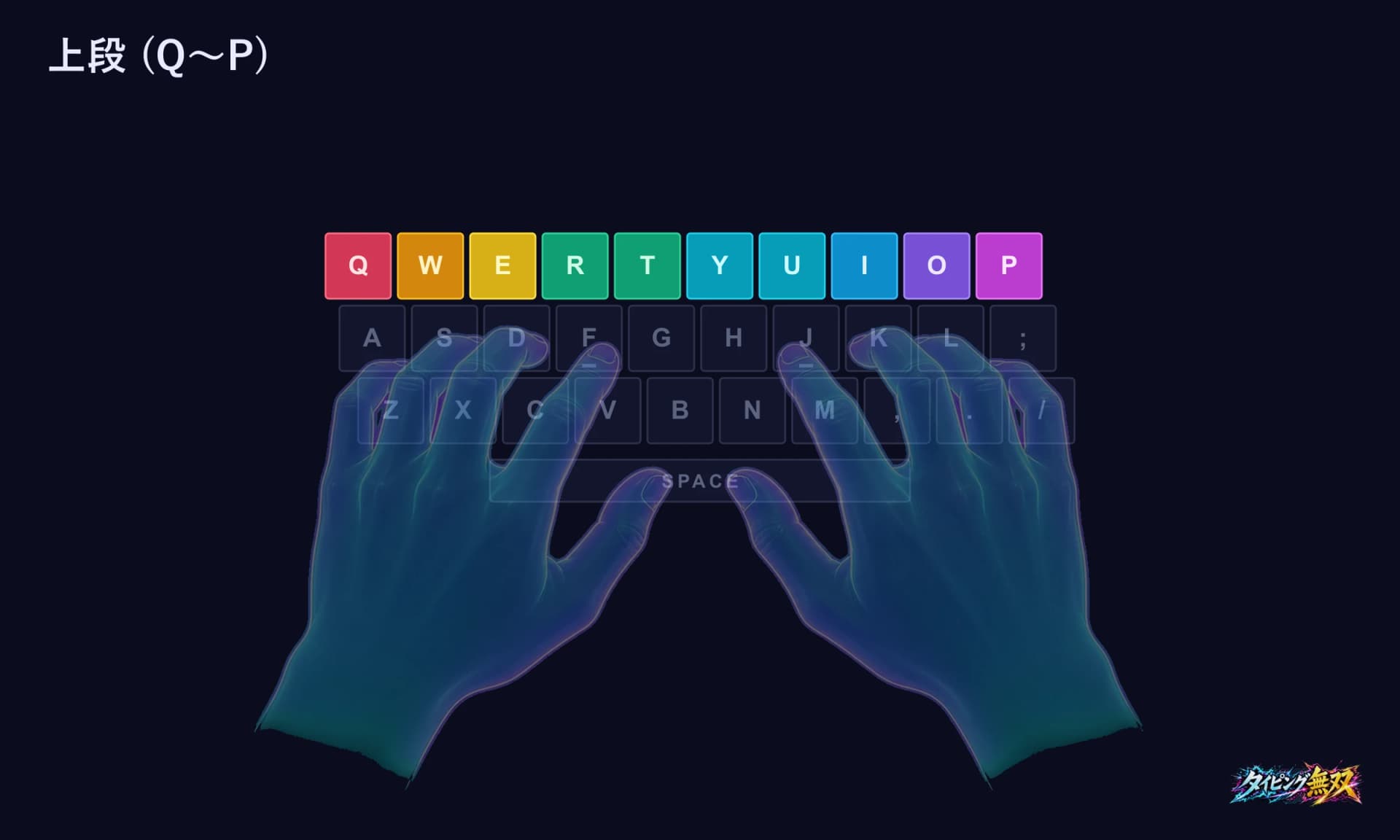
Day 4 — Reach to the top row (E·R·T·W)
Day's goal
Build the “reach one row up, return home” reflex with the left hand.
Day 4 leaves home row for the first time. Important: only fingers move — not your wrist, not your whole hand. Curl the joint slightly upward to reach the key, release and let the finger fall back to home.
Left top row is E (middle), R and T (index), W (ring). In Japanese romaji these keys carry a huge chunk of common letters (て/と/わ patterns), so the stability you build today shows up everywhere later.
Steps
- 01.Anchor on F/J, start from home
- 02.In the Home Position Dojo, practice the top-left keys (E·R·T·W)
- 03.Type words like 「eki」, 「tera」, 「takara」 with correct fingers
- 04.Eyes stay on the screen — pause and reset if they drift down
Practice volumeWork the words built around the 4 top-left keys. Hold the “reach + return” discipline and you're done.
DAY 05
Day 5 — Top right row (Y·U·I·O·P) — all five vowels
Day's goal
Right hand reaches up; all five vowels (a/i/u/e/o) can be typed without looking.
Day 5 is the inflection point. Y·U·I·O·P unlocks the rest of the vowels — and the moment all five vowels are touch-typeable, more than half of romaji Japanese input goes off-eyes.
Heads-up: O (right ring) and P (right pinky) live at the edge of the board and feel far. Don't strain the fingers — let the whole hand slide slightly right, keep the wrist loose, and let the fingers reach. Wrist stiffness here kills the top row.
Steps
- 01.Reset both hands to home before starting
- 02.In the Home Position Dojo, practice the top-right keys (Y·U·I·O·P)
- 03.Type words like 「yasai」, 「yuuki」, 「oishii」 — correct fingers only
- 04.After hitting O or P, return to L / ;
- 05.Note one easy and one hard key in your head before stopping
Practice volumeThe top-right range emphasizes vowel-heavy words. Getting through it means the five vowels are off-eyes — the half-way mark of touch typing.
DAY 06
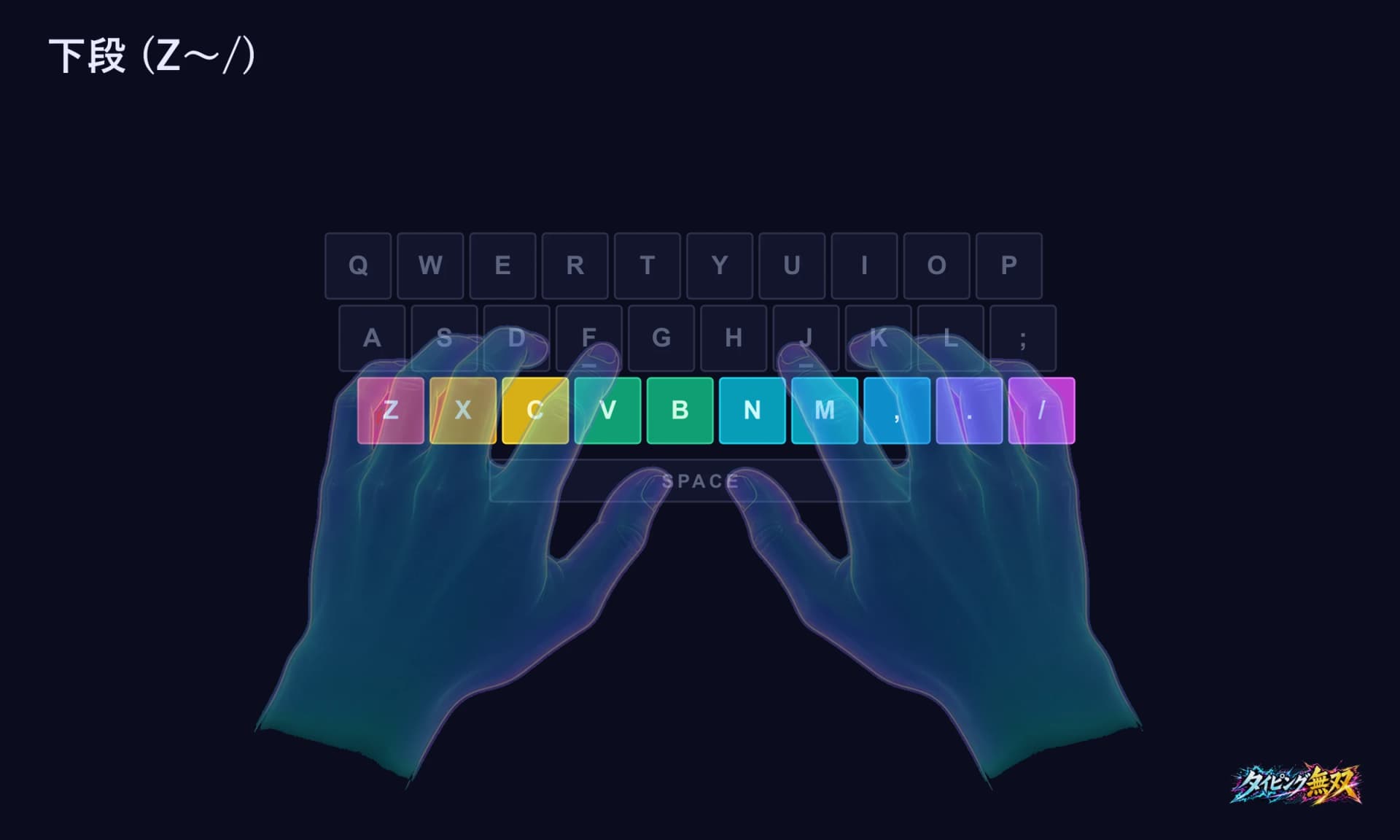
Day 6 — Bottom row (N·M·B·Z·C) + full keyboard
Day's goal
Master the “fold down” motion to the bottom row, and type real Japanese across all 26 keys.
Bottom row (N·M·B·Z·C and friends) is folded into last. Notice the motion: fingers curl inward at the second joint to drop down, not the whole hand. Wrist stays steady.
N and M are critical — Japanese romaji needs them constantly (「ん」, the m-row, multiple 「ん」 patterns). Solid right-index work on this row is what makes long passages feel stable.
Day 6 is a slightly bigger day: progress from the bottom row through the full-keyboard range in the Home Position Dojo. Once the all-keys stretch is cleared, meaningful everyday Japanese types across the whole keyboard — touch typing is roughly 90% there.
Steps
- 01.In the Home Position Dojo, practice the bottom row (N·M·B·Z·C and friends)
- 02.Type words like 「namae」, 「mainichi」, 「mikan」
- 03.Once the bottom row feels solid, continue into the full-keyboard range
- 04.Type everyday greetings/emotions across all 26 keys
- 05.Build reflex-level typing for common words
Practice volumeThe full-keyboard range spans the whole board with high-frequency Japanese words. Touch typing is essentially complete once it's off-eyes.
DAY 07
Day 7 — Sentences → Mock Combat “Apprentice”
Day's goal
Move from words to sentences, then beat Mock Combat's entry CPU, the Apprentice (WPM 30 / 85% accuracy), to close out the week.
Final day, three steps: short sentences, long sentences, then Mock Combat (the CPU duel) to test the week's work in a real match.
The week-1 graduation test is Mock Combat's entry CPU, the Apprentice. It sits at WPM 30 with 85% accuracy — tuned so that a beginner who has put in the week can just barely win. Touch typers clear the bar, eye-typers don't. That's the entire point of Day 7.
Separately, if you keep going and finish all 100 stages of the Home Position Dojo, the final gate — the Gatekeeper (WPM 30) — opens. Beating the Gatekeeper grants the 「Master / 免許皆伝」 title. Treat 免許皆伝 not as the 7-day endpoint but as a longer goal you work toward afterward (the Apprentice and the Gatekeeper share the same spec: WPM 30 / 85% accuracy).
Once you beat the Apprentice, run Speed Trial one more time. Compare against your Day 3 reading — beginners typically gain +10 to +20 WPM in the week.
Steps
- 01.In the Home Position Dojo, progress into the short-sentence range (read-and-type)
- 02.Type the long-sentence range too (recover from mistakes mid-stream)
- 03.Open Mock Combat and take on the entry CPU, the Apprentice
- 04.Beat the Apprentice → clear the week-1 graduation test
- 05.Run Speed Trial once more and compare against Day 3
Practice volumeThe Apprentice is the WPM 30 / 85% accuracy entry CPU. Beating it is the finish line of the 7-day roadmap. Push further through all 100 dojo stages to reach the final Gatekeeper and earn 免許皆伝.
PITFALLS
3 common pitfalls and how to avoid them
Pitfall 1: Trying every key on Day 1
The single biggest cause of failure. Brains can't absorb the full keyboard at once. Stick to Day 1–7 order and almost anyone clears the foundation in a week.
Pitfall 2: Quitting on Day 3 because “I got slower”
Touch typing always slows you down at first — you're overwriting eye-typing reflexes. The dip bottoms around Day 3–4 and clears around Day 5. “Got slower” means you're on schedule, not failing.
Pitfall 3: Sneaking a glance at the keys
Use F/J bumps by touch, not by looking. Visual-checking the keys never unlearns the habit. If it's tempting, drape a thin cloth over your hands — physically removing the option works.
WHAT NEXT
After day 7 — converting touch typing into raw speed
The 7 days build the foundation: eyes-on-screen typing. From here, the next month is about layering speed and accuracy on top of that foundation.
In my own experience, the month right after touch typing clicks is when WPM jumps the most — same practice time, but more of it sticks because nothing is bleeding into the screen-keyboard ping-pong anymore.
Run these three in parallel and a month later you're at a clearly higher tier:
1. Speed Trial 2–3× a week
Continue logging WPM from Day 3 and Day 7 — same mode, week after week. The personal-best curve becomes the motivation engine.
2. Accuracy Trial once daily (no-miss)
Speed work loosens fingers. The no-miss restart-on-error drill re-tightens them. One run a day, not optional.
3. CPU duels at the right difficulty
Day 7's Apprentice sits at the bottom of the difficulty ladder. Pick one tier up, aim for a 60–70% win rate — the optimal pressure for improvement. Then graduate to ranked.
If you want the structured 1-month version, read 7 Tips to Get Faster at Typing — A 1-Month Practice Order. It connects directly from this article's Day 7 endpoint (beating the Apprentice).
FAQ
FAQ
Q. Can I really learn touch typing in 7 days?
Yes for the foundation (eyes-on-screen typing of Japanese / English). Reaching competitive speed (60+ WPM) takes another 1–3 months of consistent practice. Failures at the 7-day mark almost always come from either skipping the order or skipping a day.
Q. I missed 1–2 days. Do I restart?
No. Either tack the missed stages onto the next day or extend the schedule to 8–9 days. Half-dose continuation beats a full restart every time.
Q. Is “touch typing” different from “blind touch”?
Practically no — same skill, different traditions. The article treats them as synonyms.
Q. Will this work for an elementary school student?
Days 1–3 work as-is. Hand size and finger strength can slow Days 4+, so halving each day's load and stretching to 14 days is reasonable. For classroom adoption see For Educators — classroom adoption guide.
Q. Is a laptop keyboard OK?
Completely fine — any keyboard with F/J bumps works. Postponing practice until you buy a new keyboard is a much bigger penalty than the keyboard itself.
SUMMARY
Summary — day 7 will be a different person
Touch typing is not hard. It's “the right order” + “10–15 minutes a day,” executed for a week. That's the entire move — mapped onto the Typing Musou Home Position Dojo (100 stages, master-guided), Speed Trial and Mock Combat.
Day 1 left home, Day 2 right home, Day 3 measure. Day 4–5 top row. Day 6 bottom row + full keyboard. Day 7 sentences and the Apprentice duel in Mock Combat. That's it.
A week from now the version of you typing this will visibly differ from the version that started. The two points logged on Day 3 and Day 7 are what makes the next month possible — they prove progress, and proof is what keeps practice alive.
If you're undecided, start Day 1 now. That's always the fastest moment to start.
Related
- → Home Row Position — Complete Visual Guide
- → 7 Tips to Get Faster at Typing — 1-Month Practice Order
- → 3 Real Causes of Typing Mistakes
- → WPM Average & Benchmarks (Beginner → Pro)
- → How to Get Faster at Typing
- → Why You Can't Touch-Type (and Fixes)
- → Training Weak Ring & Pinky Fingers
- → Romaji Input Chart & How to Learn It
- → All learning guides
- → Home Position Dojo (100 stages)
- → Measure your WPM in Speed Trial
- → Accuracy Trial — zero-miss practice
- → CPU Battles (5 difficulty tiers)
- → For Educators — classroom adoption
- → FAQ